

Products Description
English name:Micafungin Sodium
CAS number:208538-73-2
Molecular formula: C56H72N9NaO23S
Molecular weight: 1294.28
The EINECS:810-840-7
Related category:Microbial metabolites; Raw materials,: Anti-infection: small molecule inhibitors; Antifungal agents; Small molecule inhibitors, natural products; Pharmaceutical raw materials; Pharmaceutical and chemical industry; Medical raw materials; Pharmaceutical raw materials; API; Inhibitors; Pharmaceutical raw materials; Medical raw materials; Ingredients; Antimicrobial drugs: reagents; Biochemical reagent; Chemical reagent
Mol file: 208538-73-2.mol
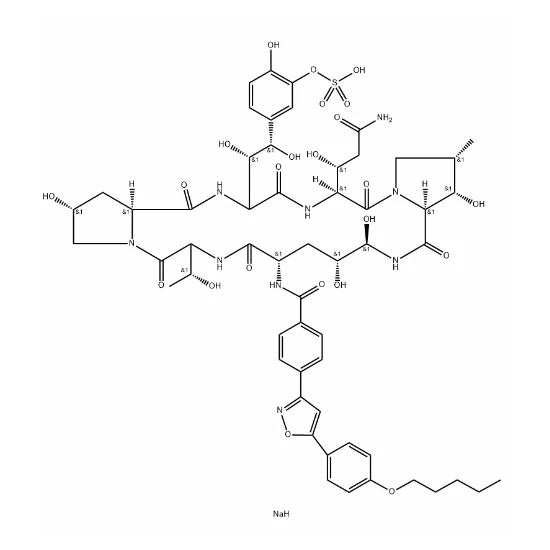
Structural formula:

Micafengin sodium properties
Melting point: >180°C(dec.)
Storage conditions: Keepindarkplace, Sealedindry Storeinfreezer, under - 20 chemicalbook ° C
Solubility: Soluble in DMSO (slight), methanol (slight), water (slight, ultrasonic treatment)
Form: solid
Color: White to almost white
Stability: hygroscopicity
CAS database: 208538-73-2
Use and synthesis of micafen sodium
Summarize
Micafunginsodium (brand name: Mikaimin is the second echinocin drug for clinical use after carpofungine. It is an antifungal drug developed by Astellas, Japan. It was first listed in Japan in 2002 and approved by FDA in the United States in May 2005. Indications are mycosemia caused by Aspergillus and candida, respiratory fungal Chemicalbook disease, and gastrointestinal mycosis. It was also used in combination with amphotericin and triazole antifungal drugs. At present, the report on the purification and desalting concentration of micafen net sodium is mainly carried out by using ion exchange chromatographic columns. Ion exchange chromatography is a time-consuming and labor-intensive purification process. Considering the heat sensitivity of micafungine sodium, a preparation method with more simplified steps, higher efficiency, more economical and easy industrial scale-up is urgently needed.
Effect
Mechanism Micafungine sodium is a water-soluble, semi-synthetic echinocinidin-like lipopeptide and a dose-dependent noncompetitive inhibitor of 1, 3-β-D glucan synthase. Glucan is a fibrous polysaccharide composed of three spiral-shaped glucose polymers. It is an essential structure of fungal cell walls and plays an important role in fungal growth and differentiation. In addition to zygomyces, other fungi such as chytrid, ascomycetes and basidiomycetes are covalently bound to the outermost dextran layer with other components of the inner layer, and dextrans are bound together through side chains to strengthen the cell wall strength. 1, 3-β-d dextran is the skeleton of the fungal cell wall, maintaining the Chemicalbook shape of the cell. The 3-β-D glucan synthase is synthesized by the polymerization of uridine diphosphate (UPD) -glucan, in which 1, 3-β-D glucan forms the main chain of the glucan layer, and 1, 6-β-linked branched chains are separated from the 1, 3-β-linked backbone. Moreover, even zygobacteria contain a large amount of 1, 3-β-D glucan during their spore stage. Thus, 1, 3-beta-D glucan synthase inhibitors are theoretically effective against all fungi. Mammalian cells have no cell wall and lack 1, 3-β-D glucan synthase, so this drug has little effect on human cells and does not have cross-resistance with existing antifungal agents.
Clinical application
Micafungine sodium is highly active not only against Candida and Aspergillus, but also against azole and amphotericin B resistant strains. Chemicalbook alone and in combination with other antifungal agents can be used to treat candidiasis and aspergillosis in immunodeficient patients and has also been found to be effective in preventing fungal infection in stem cell transplant recipients.
Drug interaction
Because Micafungine sodium is not metabolized by the cytochrome enzyme P450 system and is not a substrate for P-glycoproteins in the gut or tissues, drug interactions are uncommon. Therefore, the drug interaction is less than that of azole antifungals. In combination with tacrolimus, the pharmacokinetic data did not change. Micafenzin sodium Chemicalbook can slightly inhibit cyclosporine metabolism, so the blood concentration of cyclosporine should be monitored when the two drugs are used together. When Micafungin sodium reaches steady-state concentration, the blood concentrations of Sirolimus and nifedipine increase by 21% and 18%, respectively. Therefore, when the above two drugs are combined with Micafungin sodium, their toxic effects should be monitored and the dose should be reduced if necessary.
Preparation
(1) Micafen DIPEA salt (purity 98.80%)1.0kg was dissolved in 10L purified water, and the insoluble substances in the solution were removed by filtration; 6.6kg and 2.8kg of sodium dihydrogen phosphate were dissolved in 200L purified water, and the pH value was adjusted to 5.8 by phosphoric acid to make sodium brine solution.
(2) The sodium brine solution 30L above was added to the aqueous solution of Micafungine DIPEA salt, stirred and cooled to 10℃, filtered through the constant absorption filter device, and added to the sodium brine Chemicalbook solution during the filtration process, the addition rate of sodium brine solution was equal to the membrane flux of the membrane module; The temperature of the control system was 10℃ and the operating pressure was 0.5-1.5MPa until the detected amount of DIPEA in the filter solution was zero.
(3) The sodium brine solution is replaced with purified water, and the rate of addition of purified water is equal to the membrane flux of the membrane component until the conductivity of the filter solution is basically equal to that of the purified water.
(4) The pure Micafen sodium brine solution obtained in the preceding step was freeze-dried to obtain 920g Micafen sodium solid with yield of 99%, purity of 99.24% and residue of 5.5%.
Biological activity
Micafungin Sodium (FK463, Mycamine) is a 1, 3-beta-d-glucan synthesis inhibitor used as an antifungal drug.
In vitro study
Micafungin is an antifungal agent that does not inhibit bacteria. Although it does not directly inhibit bacteria, it can increase the survival rate of raw Chemicalbook of G.Melonella. Micafungin inhibits biofilm formation by preventing the synthesis of 1, 3-beta-d-glucan in Candidaalbicans.
Hot Tags: micafungin sodium systemic antifungal drug, China micafungin sodium systemic antifungal drug suppliers, neomycin sulfate and polymyxin b sulfate, Josamycin, rocuronium price, 53123-88-9, tacrolimus 0 0 3, 39831-55-5


